
The Podcast below is based on my article that follows underneath.
The Hiwassee River may churn and froth with the immediacy of moving water, but beneath your hull lies a geologic story that stretches back more than half a billion years.
Today’s paddle from Towee Creek to the Reliance take-out just beneath the Reliance Railway Bridge was more than a quick run through splashy Class II riffles. It was a glide through deep time, where the synclines and faults of the Southern Appalachians alter every rapid and define every eddyline.
This stretch of the Hiwassee is powered by a TVA-controlled release from Apalachia Dam, typically timed for summer recreation. What begins as a tranquil float beneath the bridge on Towee Creek soon becomes an engaging series of wave trains, ledges, and bends, with Devil’s Shoals (the final big rapid of the whitewater run) offering a Class II+ reminder that this is still whitewater territory. The water’s clarity, when releases are minimal, allows a rare look at the submerged bedrock where the Ocoee Supergroup, consisting of deep marine sediments metamorphosed into quartzite, phyllite, and slate, reveals its ancient secrets.
A Calm Beginning Before the Onslaught
Today’s crew assembles at the take-out. There, we set shuttle, combine everyone’s gear into a couple of vehicles, then drive to the put-in at Towee Creek. The Towee Creek launch allows a calm staging area where kayak skirts, helmets, and PFDs are donned.
Prepping for a whitewater trip raises the anxiety level. No one wants to be the person who forgets their paddle or helmet. I have been that person, everyone has.
Kayakers constantly count the five essentials needed before putting on the water.
1) Boat
2) Paddle
3) Helmet
4) PFD (Life Vest)
5) Skirt
Once geared up, the group paddles to the mouth of Towee Creek. A Queen Snake clings to a spindly tree branch as a reminder that we are entering nature’s domain. Excitement is in the air as members chatter in nervous anticipation, their words muted beneath the river’s din.
I paddle my kayak into the current, ferrying across the wide channel. This section of river is defined by laminar flow of crystal clear, dam-fed water. The water’s clarity allows me to peer all the way to the bedrock where submerged aquatic vegetation (SAV) grows in the cracks and crevices. Eel grass grows stalwart, yet bends and sways in the direction of the flow, perfectly suited for its habitat.
Reaching below the surface, I cup a handful of chilly Hiwassee water and splash it onto my face, preparing my senses for the inevitable, unintended splashes to come.
I’m ready for you, Hiwassee. Game On!
The Rock Beneath: The Ocoee Supergroup
The Hiwassee slices through metasedimentary rocks of the Ocoee Supergroup, originally deposited as sand, silt, and clay in a deep marine basin between approximately 750 and 540 million years ago, during the Neoproterozoic Era. These sediments were later compacted, folded, and metamorphosed into quartzite, phyllite, and slate. They now form the resistant spine of the river channel. In certain banks, you’ll see cross-bedding and foliation planes, remnants of their sedimentary origin, now transformed under tectonic heat and pressure.
Where Water Meets Structure
Geology is more than background, it shapes the river. At points where the river cuts across more resistant beds of quartzite, you’ll feel the gradient tighten and the current quicken. These are the channels where the whitewater gets its voice. In sections where water clarity allows, it is easy to see sharp, angular formations, many of which are tilted upstream. These features are not random; they form where vertical bedding planes resist erosion and eventually funnel the river into narrow, turbulent passages.
These narrow constrictions are a kayaker’s playground, delivering standing surf waves and micro-eddies perfect for eddy-hopping (my favorite), jet ferries, and peel outs. More adventurous crew members purposefully tip over in heavy current to practice their combat rolls at Thread-The-Needle.
Even novice paddlers will appreciate the consistent read-and-run nature of this river, though it’s the unseen structure below of faults and plunging folds that gives the Hiwassee its dance.
Tectonic Origins and River Alignment
The Alleghanian Orogeny, occurring roughly between 325 and 260 million years ago during the late Paleozoic Era, was one of the final major mountain-building events that formed the Appalachian Mountains. It resulted from the collision of ancestral North America (Laurentia) with Gondwana (primarily Africa), leading to intense folding, faulting, and metamorphism across the Blue Ridge province.
These massive compressional forces caused the ancient sediments to crumple like a rug pushed against a wall, stacking terranes and tilting rock layers into the orientations we see today.
The Hiwassee itself often follows these structural weaknesses. If you study the river’s curves from a topo map, you’ll notice long straightaways followed by tight, angular bends. These are classic signs of a river obeying the rules of structural geology and taking advantage of natural weaknesses in the bedrock.
Ecology Thrives in the Gradient
Where geology creates variation in flow and depth, life responds. Riffles formed by resistant quartzite outcrops oxygenate the water, supporting macroinvertebrates, trout, and darters, while the deeper pools, between shoals and further down river into the lower Hiwassee, shelter bass and catfish.
Fishermen play on these waters too, casting their lines into hospitable pools. Sometimes, kayakers and fishermen have an adversarial relationship as we both try to enjoy the water. If we both give each other space, we can all find our own enjoyment.
Above the river, the slopes are often composed of weathered metamorphic rock, occasionally interbedded with limestone. As these materials break down and collect as colluvium, they support eastern hemlocks, mountain laurel, and occasional redbuds clinging to fractured ledges. I often see hikers, on the side of the river, enjoying the section of the John Muir trail that intersects the Hiwassee River watershed.
Skill Building in a Gentle Environment
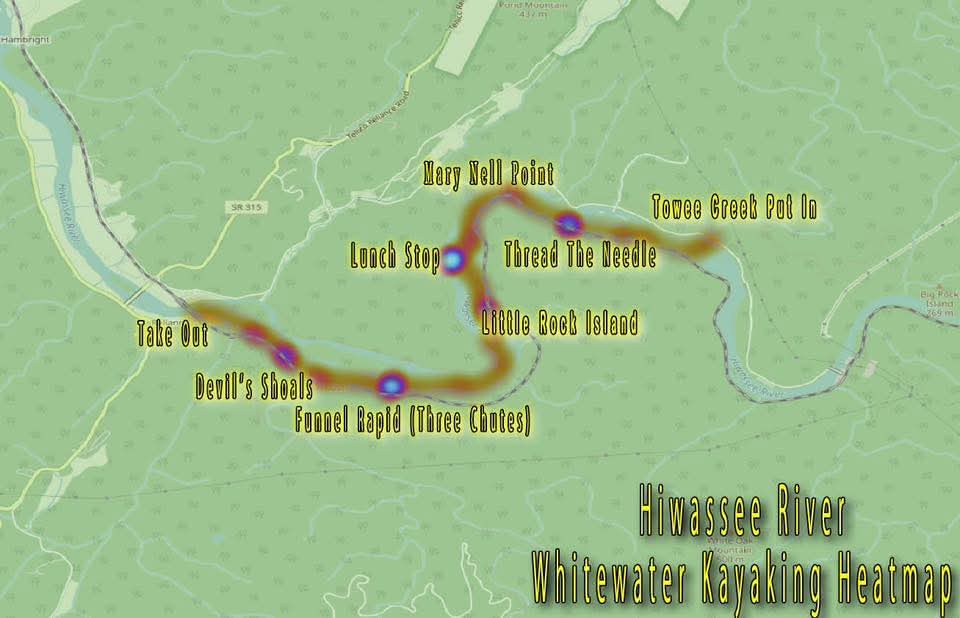
Paddlers have varying styles and desires. Some kayakers enjoy “bombing” the river by just paddling downstream, making only a few stops and not playing in the river’s features. Conversely, my crew takes hours running the Hiwassee, seeking out micro eddies, looking for perfect surf waves, and challenging each other to ferry the more difficult currents.
Thread-the-Needle, Mary Nell Point, Stair Steps, Little Rock Island, and 3 Chutes w/Funnel Rapid provide excellent training grounds for bigger water.
In fact, I think of the entire run as a preparation for a final test at Devil’s Shoals. Those paddlers with a gleam in their eyes will receive an invitation to follow me into an “Eddy and Ferry Frenzy.” Most people run Devil’s Shoals without looking back, but not my group. We catch every eddy, peel out into the chaos, attain back upstream, and do it all over again, over and over and over again. These drills on the relatively gentle Hiwassee are the perfect training ground for much larger, less-gentle whitewater like the Tellico and Ocoee Rivers.
The Take-Out, and a Final Thought
By the time we reach the Reliance take-out, we’ve traveled not just a few river miles, but across multiple geologic stories. And each geologic story is folded, faulted, and carried downstream by the endless motion of water.
Our muscles aching and our minds churning with excitement from the day, we change into dry clothes and rack our kayaks back onto our cars. Wet gear steams in the Tennessee sun. The Hiwassee River Scenic Railroad train sounds its horn as it crosses the river on the Reliance Railroad Bridge as if to say “thanks for visiting, come again soon.”
We come away from the river stronger, more skilled, closer to nature, and closer to each other.
SYOTR!
Clyde Outside!
References:
https://ajsonline.org/article/60388.pdf
https://www.tva.com/environment/environmental-stewardship/aquatic-plant-id
https://ngmdb.usgs.gov/Geolex/Units/Hiwassee_2091.html
https://pubs.geoscienceworld.org/gsa/books/edited-volume/862/chapter-abstract/3920427/Alleghanian-orogen?redirectedFrom=PDF
https://hiwassee.tu.org/fish-identification/
Leave a Reply
You must be logged in to post a comment.